Skip to content

The Traveling Taco by guest author Mia Wenjen, featuring a Giveaway


THE TRAVELING TACO
Written by Mia Wenjen
Illustrated by Kimberlie Clinthorne-Wong
(Red Comet Press; $19.99, Ages 5 and up)


Let’s welcome today’s guest author, Mia Wenjen. Her most recent picture book, The Traveling Taco, takes readers around the world with some surprising food facts.


Did you know many well-known dishes are food immigrants? The Al Pastor Taco traveled from Lebanon to Puebla, Mexico… French fries originated in Belgium… And pasta arrived in Italy long before Marco Polo visited China. This fascinating nonfiction book featuring rhyming text takes the reader on travels around the world to celebrate foods, their history, and surprising origins. [picture book, ages 5 and up]


We are also giving away a signed copy of her book. Please fill out the Rafflecopter at the bottom to enter.


Now let’s learn more about The Traveling Taco!


What inspired you to write The Traveling Taco?

My husband and I like to watch food documentaries. We watched The Taco Chronicles on Netflix, which showcases a different type of taco on each episode. When I learned that the Al Pastor taco comes from Lebanese people who settled in Puebla, Mexico, and brought their shawarma tradition with them. They adapted it for what was available. Pork was swapped out for lamb. Spices were changed. Flatbread was switched to corn tortillas. I was fascinated by “food that traveled” and started researching food that you think is iconic to a country, but was actually introduced by immigrants. Like fish and chips!


What is your favorite spread in the book?

The Jerk Chicken spread is probably the one that we worked on the longest to get it right. Jamaica is portrayed in such a lovely way with the plants and trees, and the setting ended up being contemporary.

e
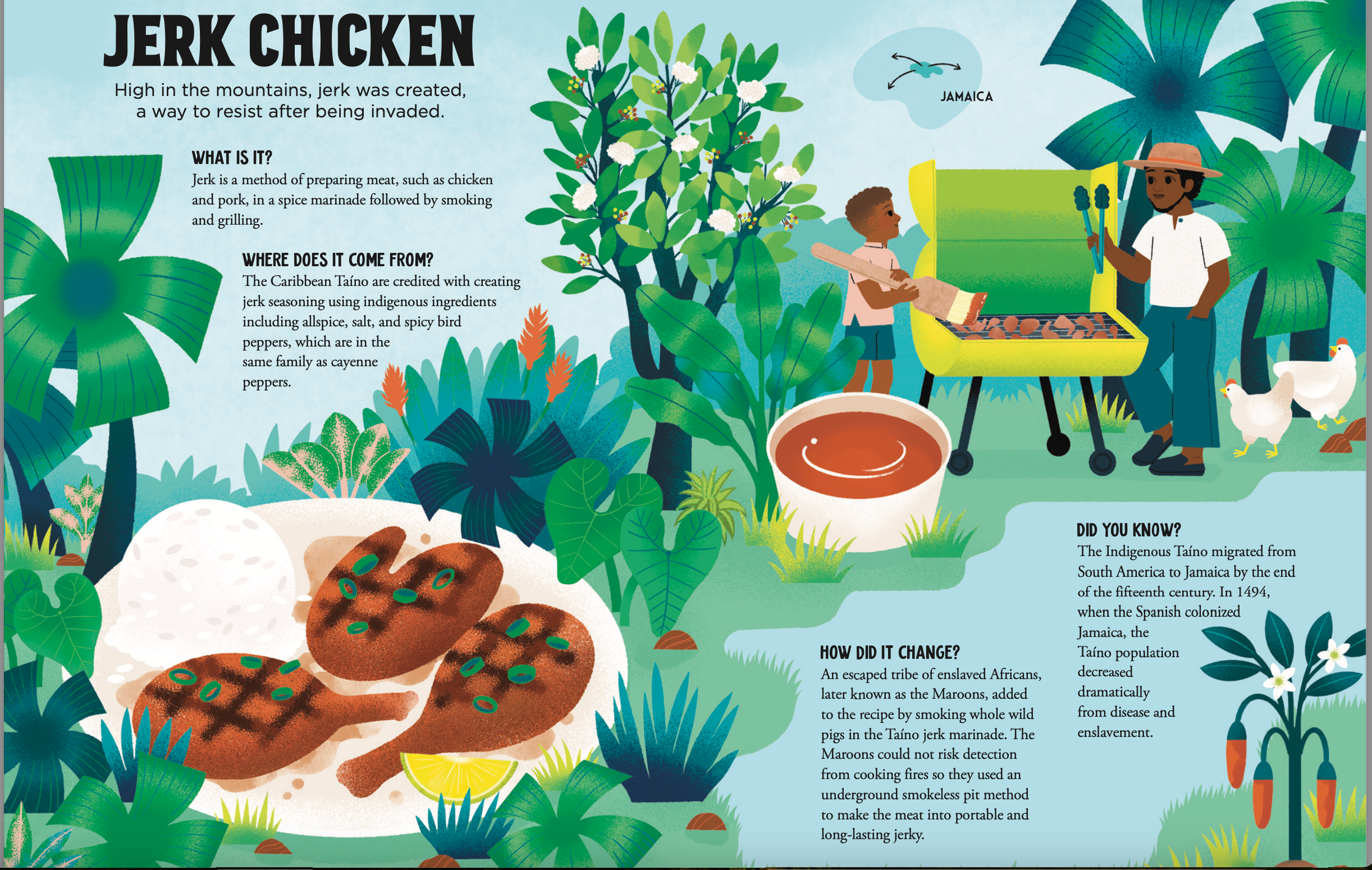
Jerk Chicken from Jamaica featured in The Traveling Taco by Mia Wenjen


I heard there is a song about The Traveling Taco! How did that happen?

Daria World Music created this song for my book. She wrote the lyrics, sang the song, and hired an animator to create the video. I thought it would be nice to have if a teacher or librarian is using the book in the classroom. A song is a nice warm-up to storytime!


What do you hope readers will take away from your book?

I hope readers realize that many of the foods we know and love would not be available if not for immigrants who so generously and graciously shared their food cultures. It is also fun to learn about other cultures through food, so I hope this encourages kids to be adventurous at the dinner table and be curious enough to want to learn more.

What’s next for you?

I have a few more picture books coming out:

Fortune Cookies for Everyone, illustrated by College Kong-Savage, comes out in October. It’s the story of who invented the fortune cookie, an American invention! It takes us back to WWII and Japanese Concentration Camps (also known as Internment Camps). It’s co-published with the Smithsonian and Red Comet Press.

e

FORTUNE COOKIES FOR EVERYONE! by Mia Wenjen, illustrated by Colleen Kong-Savage, Published by Red Comet Press


Green Homes, Happy Planet: Sustainable Houses Around the World
, illustrated by Mary Atwood and published by Sleeping Bear Press, comes out in February of 2026.

Barbed Wire Between Us, illustrated by Violeta Encarnación and published by Red Comet Press, comes out in March of 2026.

To Market, To Market … Around the World, illustrated by Peng Wu and published by Barefoot Books, comes out in the Fall of 2026.

Postcards by Malcolm X, illustrated by Keith Henry Brown and published by Red Comet Press, comes out in January of 2027.


BUY THE BOOK:

You can purchase a copy of The Traveling Taco and support a local independent bookseller

by clicking here: Newtonville Books


Author Mia Wenjen Photo Credit: Tai Lee.


AUTHOR BIO:

Mia Wenjen blogs at PragmaticMom.com. She is the President and Co-Founder ReadYourWorld.org, a nonprofit that puts diverse children’s books into the hands of readers. Her picture books include The Traveling Taco, We Sing From the Heart, and Fortune Cookies for Everyone published by Red Comet Press; Food for the Future, published by Barefoot Books; and Sumo Joe, published by Lee and Low.

Honors for her books include: ALSC Notable Children’s Book, Carter G. Woodson Book Award Honoree, Orbis Pictus Recommended Book for Outstanding Nonfiction for Children, Massachusetts Book Award Long List, Julia Ward Howe Prize for Children’s Literature Winner, California Eureka Non-Fiction Award Honor Book, Notable Social Studies Trade Books for Young People Winner, Bank Street Best Children’s Books of the Year, and Junior Library Guild Gold Selection.

To learn more, check out her website, MiaWenjen.com, and follow her on social media (see below).

Mia’s children’s books:

We Sing from the Heart, The Traveling Taco, Barbed Wire Between Us, Boxer Baby Battles Bedtime!, Food for the Future, Sumo Joe, and Changing the Game.

Connect with Mia:
Blog: PragmaticMom, Instagram: PragmaticMom,  Twitter/X /X: PragmaticMom, Pinterest: PragmaticMom, FaceBook: PragmaticMom,
LinkedIn: Mia Wenjen, YouTube: Mia Wenjen, TikTok: ReadYourWorld,
BlueSky: PragmaticMom, Threads: Mia Wenjen.

The Traveling Taco SIGNED book giveaway!

Cover Reveal for THE TRAVELING TACO by Mia Wenjen


We are giving away a signed copy of her book. Please fill out the Rafflecopter below to enter. We can only mail to U.S. and APO addresses.

a Rafflecopter giveaway

Share this:

Picture Book Biography – The Fabulous Fannie Farmer


THE FABULOUS FANNIE FARMER:
Kitchen Scientist and America’s Cook

Written by Emma Bland Smith

Illustrated by Susan Reagan

(Calkins Creek; $18.99, Ages 7-10)


The_Fabulous_Fannie_Farmer_cover_young_Fannie_testing_soup


 Starred Review – School Library Journal

Written by Emma Bland Smith and illustrated by Susan Reagan, The Fabulous Fannie Farmer is a humorous and fascinating story of a quiet, kitchen revolutionist who transformed the notion of home cooking from “meaningless” work to a serious business. 


The Fabulous Fannie Farmer int1 young Fannie in 1800s peeling potatoes.
Interior spread from The Fabulous Fannie Farmer: Kitchen Scientist and America’s Cook written by Emma Bland Smith and illustrated by Susan Reagan, Calkins Creek Ⓒ2024.


Like many girls during the late 1800s, Fannie Farmer most likely grew up learning how to cook in her home kitchen, using recipes that had been in her family for generations. Yet recipes in Fannie’s day were more poetic than precise. Phrases like “a suspicion of,” “a good lump,” and “as many as may be necessary” not only hindered consistent results but perpetuated the myth that cooking was “all about feminine instincts.” I love how author Emma Smith emphasizes the strangeness and silliness of this misguided belief by adding humor to her storytelling. Sentences like, “instructions were often cloudier than clam chowder” and “… who needs standard measurements when you’ve got your trusty feminine instincts, right?” create a light-hearted, conversational tone that brings Smith’s retelling of culinary history to life. Susan Reagan’s period-perfect illustrations add whimsy and authenticity, allowing readers to see what life was like at the turn of the last century. 

Despite suffering the aftereffects of (what many believe was) polio, Fannie continued to cook and bake in her kitchen, testing out recipes with precision by using measuring cups and spoons. When she enrolled in the Boston Cooking School at age thirty-one, Fannie truly excelled. As a student, then assistant, and finally a principal, she taught her students to think like “kitchen scientists.” 


The Fabulous Fannie Farmer int2 unclear recipe measurements.
Interior art from The Fabulous Fannie Farmer: Kitchen Scientist and America’s Cook written by Emma Bland Smith and illustrated by Susan Reagan, Calkins Creek Ⓒ2024.


When she fulfilled her wish to rewrite the school’s old cookbook, she and her students tested every recipe, transforming the school’s kitchen into a chemistry lab. Fannie paved the way for cooks and bakers everywhere to finally have access to clear and precise recipes with reliable results. But more than that, Fannie created a cultural shift in the way people thought about home cooking. Since it involved “planning and budgeting, health and nutrition,” she insisted the work deserved serious recognition. 

The Fabulous Fannie Farmer opens readers’ eyes to the importance of Fannie’s impact on our everyday lives. A great resource for teachers, this book can also be fun for readers at home, learning a bit of culinary history while snacking on a treat. Two recipes from Fannie’s book and extensive back matter are included.

  • Reviewed by Armineh Manookian


Click here for a soup recipe.


Share this:

Nonfiction Picture Book Review for Women’s History Month – Chef Edna


CHEF EDNA:
Queen of Southern Cooking, Edna Lewis

Written by Melvina Noel

Illustrated by Cozbi A. Cabrera

(Cameron Kids; $18.99, Ages 4-8)


Chef Edna cover queen of southern cooking edna lewis.


This mouthwatering, treat of a book introduces readers to Edna Regina Lewis, with illustrations that pair deliciously with the prose. I was ready to book a trip to the South to sample all the tasty cuisine mentioned in Chef Edna written by Melvina Noel and illustrated by Cozbi A. Cabrera. Just look at that inviting cover! It speaks to exactly what this picture book is all about.


Chef Edna int1 when Edna grew up on a farm.
Interior spread from Chef Edna: Queen of Southern Cooking, Edna Lewis written by Melvina Noel and illustrated by Cozbi A. Cabrera, Cameron Kids ©2023.


Growing up on a farm in Freetown, Virginia, Edna was one of six children. She spent her childhood “cooking with her mother, Mama Daisy.” Life on a farm offered fresh fruit, vegetables, meats, and fish year-round as well as the opportunity for young Edna to learn every recipe. She made her mama’s biscuits “so many times she could make them by heart.” That and other tricks, such as listening to a cake to know whether it’s done (A bubbling sound meant it needed to cook more. No sound meant it was done.) became ingrained in Edna.


Chef Edna int2 making biscuits
Interior art from Chef Edna: Queen of Southern Cooking, Edna Lewis written by Melvina Noel and illustrated by Cozbi A. Cabrera, Cameron Kids ©2023.


When Edna’s father passed away, she left home at age 15 to work to help support her mother and the family. She headed to New York and did a host of jobs. Her seamstress skills brought her to the attention of celebrities and soon she was “making clothes for movie stars.” One of my favorite illustrations not shown here is of Edna strolling down a Manhattan street wearing one of her own designs with African motifs and “bright, bold colors.” And, while this brought in much-needed money, Edna still yearned for the farm in Freetown, being with family, and enjoying all the delicious Southern food she was raised on.

Edna met many people through her seamstress work. She “catered events and threw dinner parties for her new friends.” Everyone appreciated her scrumptious cooking infused with a love of the South. Demand grew. It’s easy for us to forget that today, with such a variety of food available that, in late 1940s New York, a female chef, let alone a Black female chef, serving up flavors of her hometown down south, was not common on the Upper East Side where she opened a restaurant with a partner. Famous people including poets, playwrights, and even a First Lady flocked there to see for themselves what Southern cuisine was all about.


Chef Edna int3 simple pure ingredients.
Interior spread from Chef Edna: Queen of Southern Cooking, Edna Lewis written by Melvina Noel and illustrated by Cozbi A. Cabrera, Cameron Kids ©2023.


With New York now her home, Edna continued to seek out “fresh fruit, vegetables, meat, and fish. Fresh seasonal farm-to-table ingredients for Southern cooking,” at Union Square Green Market. When I was growing up that market had long disappeared but it’s back again which I know would make Edna smile. Cabrera’s artwork in muted tones with brush strokes showing, conveys a thriving market of a bygone era.

In her lifetime, Edna the granddaughter of formerly enslaved people, worked at many different jobs where her creativity was put to good use whether as a window dresser, a seamstress, a cooking teacher, a cookbook author, or a chef. This “Grand Dame of Southern Cooking” worked in her later years to preserve Southern food, and was honored not only with numerous awards, but was featured on a U.S. Postal stamp in 2014! Since dates are not mentioned, readers may not always get a clear sense of the timespan in this biography but it’s clear from the art and backmatter that Edna never really slowed down noting that Edna worked “well into her early seventies.” The author has chosen an inspiring subject for this picture book that might even influence young readers to pursue a career as a chef.

After you finish the book, be sure to read Noel’s interesting Author’s Note and try your hand at Edna’s “Biscuits for Two or Three.” I know I will! Don’t forget to look under the book jacket for a sweet “undies” surprise from Cabrera.

  • Reviewed by Ronna Mandel


Want to read more for Women’s History Month? Click here.

Share this:
Back To Top