Skip to content

Picture Book Review Guest Post – The Bagel Who Wanted Everything

GET THE SHMEAR
BECAUSE SCOOPS ARE FOR ICE CREAM!

AN INTERVIEW WITH AUTHOR-ILLUSTRATOR
ALAN SILBERBERG

BY LAUREN KASIARZ


lThe Bagel Who Wanted Everything cover plain bagel.


THE BAGEL WHO WANTED EVERYTHING

Written and illustrated by Alan Silberberg

(Viking Books for Young Readers; $18.99; Ages 3-7)


FROM THE PUBLISHER:

“The Lady Pancake and Sir French Toast series meets The Food Group books in this tale of a plain bagel who dreams of being more!“

FROM KIRKUS:

“With charm and a lesson of self-empowerment, this bagel book has lox to recommend it.”

THE INTERVIEW:

Lauren Kasiarz: Let’s welcome today’s guest, Alan Silberberg. His most recent book, The Bagel Who Wanted Everything, is sweet, silly, and full of self-discovery.

Now let’s learn more about The Bagel Who Wanted Everything!

LK: What feels most unique to you about this story compared to ones you’ve previously written?

Alan Silberberg: The others are silly stories about Jewish holidays and funny food characters. In this book, though, it’s funny food characters, but I feel like I’m able to put more of my heart into it and say more about the human condition. It’s more of a heartfelt story for me.


The Bagel Who Wanted Everything int1 plain bagel and plain parents.
Interior art by Alan Silberberg from The Bagel Who Wanted Everything, written and illustrated by Alan Silberberg, Viking BYR ©2025.


LK: How did you come up with the idea for The Bagel Who Wanted Everything?

AS: This book came about as most of my books do – as a title. So then, I had to figure out the story and I didn’t want it to be a story about “plain is no good because plain is just plain.” I really struggled with telling this individualization story without denigrating being plain because plain’s awesome! And so, when I wrote up these other types of bagels, it took me a while to find that bagels are just one thing. And one isn’t better than the other.

LK: What was the most difficult aspect of writing The Bagel Who Wanted Everything?

AS: The hardest part for me is that I knew the sentence, “In a world of everything, why do I have to be one thing?” But I struggled with the ultimate message. How do I say it’s ok to be everything? By everything, I mean any combination or non-combination. I didn’t want to be judgey. And drawing, when you’re playing with a lot of brown tones, it was hard for me to get color into the book.


The Bagel Who Wanted Everything int2 each type of bagel was what it was meant to be.
Interior art by Alan Silberberg from The Bagel Who Wanted Everything, written and illustrated by Alan Silberberg, Viking BYR ©2025.

e

LK: Did you have any surprises while crafting this book?

AS: I didn’t have any surprises but I did have a moment where I said, “this isn’t funny. I’ve got to be funny.” And going back through it and saying, “well, I can’t really have a grandmother bagel be moldy and old. And then I went, well, maybe that’s funny.” So I had to push myself, not that it’s not a funny book, but I didn’t want it just to be cute.


The Bagel Who Wanted Everything int 3 confused bagel asks why be just one thing.
Interior art by Alan Silberberg from The Bagel Who Wanted Everything, written and illustrated by Alan Silberberg, Viking BYR ©2025.


e

 Author Lauren Kasiarz Photo Credit Ann Marie Collins.
Lauren Kasiarz Photo Credit Ann Marie Collins.

Today’s guest post is by Lauren Kasiarz.
Watch the extended video interview with Alan Silberberg,
hosted by Lauren Kasiarz of @diversejewishbooks, on YouTube.
You can also find Lauren on IG here.

Share this:

The Traveling Taco by guest author Mia Wenjen, featuring a Giveaway


THE TRAVELING TACO
Written by Mia Wenjen
Illustrated by Kimberlie Clinthorne-Wong
(Red Comet Press; $19.99, Ages 5 and up)


Let’s welcome today’s guest author, Mia Wenjen. Her most recent picture book, The Traveling Taco, takes readers around the world with some surprising food facts.


Did you know many well-known dishes are food immigrants? The Al Pastor Taco traveled from Lebanon to Puebla, Mexico… French fries originated in Belgium… And pasta arrived in Italy long before Marco Polo visited China. This fascinating nonfiction book featuring rhyming text takes the reader on travels around the world to celebrate foods, their history, and surprising origins. [picture book, ages 5 and up]


We are also giving away a signed copy of her book. Please fill out the Rafflecopter at the bottom to enter.


Now let’s learn more about The Traveling Taco!


What inspired you to write The Traveling Taco?

My husband and I like to watch food documentaries. We watched The Taco Chronicles on Netflix, which showcases a different type of taco on each episode. When I learned that the Al Pastor taco comes from Lebanese people who settled in Puebla, Mexico, and brought their shawarma tradition with them. They adapted it for what was available. Pork was swapped out for lamb. Spices were changed. Flatbread was switched to corn tortillas. I was fascinated by “food that traveled” and started researching food that you think is iconic to a country, but was actually introduced by immigrants. Like fish and chips!


What is your favorite spread in the book?

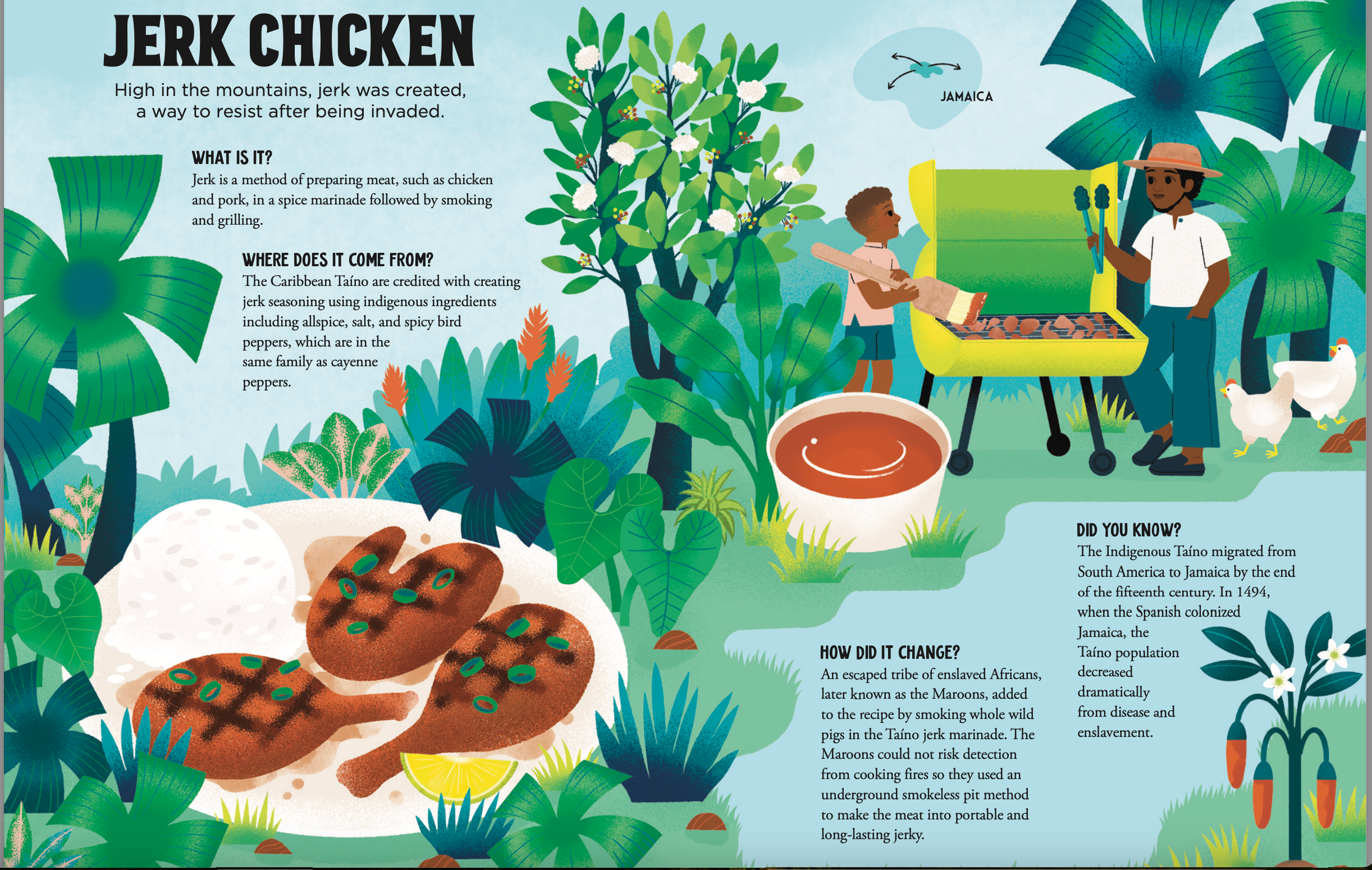
The Jerk Chicken spread is probably the one that we worked on the longest to get it right. Jamaica is portrayed in such a lovely way with the plants and trees, and the setting ended up being contemporary.

e

Jerk Chicken from Jamaica featured in The Traveling Taco by Mia Wenjen


I heard there is a song about The Traveling Taco! How did that happen?

Daria World Music created this song for my book. She wrote the lyrics, sang the song, and hired an animator to create the video. I thought it would be nice to have if a teacher or librarian is using the book in the classroom. A song is a nice warm-up to storytime!


What do you hope readers will take away from your book?

I hope readers realize that many of the foods we know and love would not be available if not for immigrants who so generously and graciously shared their food cultures. It is also fun to learn about other cultures through food, so I hope this encourages kids to be adventurous at the dinner table and be curious enough to want to learn more.

What’s next for you?

I have a few more picture books coming out:

Fortune Cookies for Everyone, illustrated by College Kong-Savage, comes out in October. It’s the story of who invented the fortune cookie, an American invention! It takes us back to WWII and Japanese Concentration Camps (also known as Internment Camps). It’s co-published with the Smithsonian and Red Comet Press.

e

FORTUNE COOKIES FOR EVERYONE! by Mia Wenjen, illustrated by Colleen Kong-Savage, Published by Red Comet Press


Green Homes, Happy Planet: Sustainable Houses Around the World
, illustrated by Mary Atwood and published by Sleeping Bear Press, comes out in February of 2026.

Barbed Wire Between Us, illustrated by Violeta Encarnación and published by Red Comet Press, comes out in March of 2026.

To Market, To Market … Around the World, illustrated by Peng Wu and published by Barefoot Books, comes out in the Fall of 2026.

Postcards by Malcolm X, illustrated by Keith Henry Brown and published by Red Comet Press, comes out in January of 2027.


BUY THE BOOK:

You can purchase a copy of The Traveling Taco and support a local independent bookseller

by clicking here: Newtonville Books


Author Mia Wenjen Photo Credit: Tai Lee.


AUTHOR BIO:

Mia Wenjen blogs at PragmaticMom.com. She is the President and Co-Founder ReadYourWorld.org, a nonprofit that puts diverse children’s books into the hands of readers. Her picture books include The Traveling Taco, We Sing From the Heart, and Fortune Cookies for Everyone published by Red Comet Press; Food for the Future, published by Barefoot Books; and Sumo Joe, published by Lee and Low.

Honors for her books include: ALSC Notable Children’s Book, Carter G. Woodson Book Award Honoree, Orbis Pictus Recommended Book for Outstanding Nonfiction for Children, Massachusetts Book Award Long List, Julia Ward Howe Prize for Children’s Literature Winner, California Eureka Non-Fiction Award Honor Book, Notable Social Studies Trade Books for Young People Winner, Bank Street Best Children’s Books of the Year, and Junior Library Guild Gold Selection.

To learn more, check out her website, MiaWenjen.com, and follow her on social media (see below).

Mia’s children’s books:

We Sing from the Heart, The Traveling Taco, Barbed Wire Between Us, Boxer Baby Battles Bedtime!, Food for the Future, Sumo Joe, and Changing the Game.

Connect with Mia:
Blog: PragmaticMom, Instagram: PragmaticMom,  Twitter/X /X: PragmaticMom, Pinterest: PragmaticMom, FaceBook: PragmaticMom,
LinkedIn: Mia Wenjen, YouTube: Mia Wenjen, TikTok: ReadYourWorld,
BlueSky: PragmaticMom, Threads: Mia Wenjen.

The Traveling Taco SIGNED book giveaway!

Cover Reveal for THE TRAVELING TACO by Mia Wenjen


We are giving away a signed copy of her book. Please fill out the Rafflecopter below to enter. We can only mail to U.S. and APO addresses.

a Rafflecopter giveaway

Share this:

Best Children’s Books for Passover 2025


SEVEN NEW CHILDREN’S BOOKS

FOR PASSOVER 2025

~  A ROUNDUP ~


If only I had more time! This year’s offering of new Passover books for children seems to be the largest I’ve seen in a long time. It was so hard to choose what to include, and I really hoped to cover them all. Please scroll to the end to see other books I was unable to review but recommend.


REVIEWS:

My Seder Plate cover seder plate shaped board book.MY SEDER PLATE
Written by Kristen Weber
Illustrated by Yaara Cellier
(Clarion Books; $10.99, Ages 0-4)

My Seder Plate: A Passover Book is Kristen Weber’s debut, and it’s a charming one! This book would have been a big hit in my home when my children were growing up. It’s not only richly illustrated, but it includes interesting seder details for those who are older. At the same time, it can be appreciated as a clever interactive way for little ones to simply enjoy the pictures during the celebration. Traditionally, the seder plate, like the board book, is round, “with spots for special foods.” Each food represented is significant in the retelling of the Passover story.

Open the sturdy book to reveal the seder plate and its contents on one side, a multigenerational family on the other. It includes the food name in Hebrew and in English. One word I have learned in Hebrew from attending many seders is Beitzah, egg, the second food shown. Each food item explained is in bold. The font is smaller for the more detailed portion, which a relative might explain, or perhaps an older sibling, a cousin, or a family friend. I also like how the first paragraph is in verse, which will add to a youngster’s engagement.

“A roasted egg sits on our plate,
warm and round and hard,
a symbol of the cycle of life
and hope for a new start.

The egg can be both a reminder
of the sacrifices Jewish people have
made and a symbol of new life.”

Now that all the Passover foods are covered, it’s time to try them! A big positive about My Seder Plate is that children can keep it with them and follow along while also being entertained by the art and the surprises that await them with every page turn. Chag Passover Sameach! •Reviewed by Ronna Mandel


Matzah Day cover family members holding matzah.MATZAH DAY!
Written by Charlotte Offsay
Illustrated by Jason Kirschner
(Holiday House; $18.99, Ages 3-6)

Charlotte Offsay has a talent for writing picture books with rhyme that 1. always entertain, 2. propel the story forward, and 3. employ a catchy rhyme scheme that invites read-alouds. She did it with Challah Day! and succeeds once again with Matzah Day!

This lively written and whimsically illustrated holiday story celebrates the popular Passover cracker made from water, salt, and flour that can be enjoyed in as many ways as matzah is spelled. You can even see it in this roundup spelled matzah, matzoh, and some times matza, and matzo. Are there other spelling variations that I don’t know about? Maybe! But no matter how you spell it, there is much to love about the food that came to be when “The Jewish people fled from Egypt in such a hurry that they didn’t have time to wait for their dough to rise.”

Don’t miss the three recipes included to try with the help of a parent, as well as information about exactly what matzah is, what Passover is, and why we eat matzah for Passover. I appreciated the tight rhyme when Offsay describes the different (and delicious) ways matzah can be eaten as the family gets fuller and fuller. “Like it salty, plain, or sweet? No wrong way to eat this treat! Toffee, chocolate, salted top. Once you start, it’s hard to stop.” Too right. It’s one of my Passover weaknesses, along with matzah brei, a breakfast matzah mashup my family loves year-round. The zany spreads where Kirschner has made the family members smaller sized as they play on the larger scaled ingredients are quite funny. As a feline fan, I also appreciate the adorable kitty added for good measure. What a great new read to add to your family’s Passover picture book collection. •Reviewed by Ronna Mandel


Written by Alan Katz
Illustrated by Adam Auerbach
(Harper Collins BYR; $12.00, Ages 4-8)

The Cohen family is enjoying the Passover seder at Grandpa Murray and Grandma Norma’s home. It is time to hide the afikomen and Grandpa Murray is searching for the perfect spot which his grandchildren won’t be able to locate. However, when he hears that the matzah ball soup is being served, he rejoins his family. After the meal, it’s time to find the afikomen . . .  but the kids don’t know where their grandfather hid it, and Grandpa Murray doesn’t remember either! So, where is the afikomen? We probably all can relate to this.

Young detectives will enjoy the pen and ink illustrations, which combine different angles and vantage points, adding both interest and a sense of mystery to the story, which has a simple yet satisfactory solution. •Reviewed by Freidele Galya Soban Biniashvili


Happy Passover, Edie Rose cover Edie hugging young neighbor Mia.HAPPY PASSOVER, EDIE ROSE!
Written by Joy Preble
Illustrated by Valeria Cis
(Kar-Ben Publishing; $18.99, Ages 4-9)

Though not new to writing for children, Joy Preble’s debut picture book, Happy Passover, Edie Rose!, is a heartwarming take on the Passover story. Young readers will admire the meaningful relationship between an older woman, Edie Rose, and a young girl, Mia, neighbors in their close-knit apartment building. Edie Rose has created a tradition with her neighbors where they gather together in her home for a Passover seder that not only includes matzah ball soup and charoset but takes them on a journey similar to the one Moses and the Jewish people took from Egypt to the land of Israel.

Early on, Valeria Cis’s appealing artwork details Edie Roses’s seder to-do list along with illustrations of the smiling and diverse mix of neighbors. And, of course, Edie’s adorable red and white dog, Mo, is always by her side. Turning the page, we see memories of past seders with Edie and her friends coloring paper frogs and crossing through Edie’s living room pretending it’s the Red Sea. Mia spends a great deal of time with Edie when her mother works late, and despite being from different generations, the two have become great friends.

Next up, Edie is baking her chewy macaroons just before this year’s Passover. Mia’s mom walks through the door as Edie carries the hot, out-of-the-oven macaroons from the kitchen. Preble skillfully sets up the scene as Mo, unable to control his sniffer and overjoyed by the yummy aroma, dashes up to steal a cookie. The two collide. Macaroons scatter everywhere. Edie ends up in the hospital with a broken arm. Mia, with her caring neighbors’ help brings Passover to Edie. Just like in the Passover story, young Mia creates the best seder ever. “We marched together,” Mia tells Edie proudly. “All of us. Like you said.”

This charming tale with a twist asks kids why this night is different from all other nights, but this year, the answer is that all the neighbors worked together for Edie Rose—a wonderful lesson in kindness and gratitude. I loved how it showed that holidays don’t always have to be spent with blood relatives. Friends are family, too. •Reviewed by Ronda Einbinder


roadside seder cover seder on a logROADSIDE SEDER
Written by Anna Levine
Illustrated by Naama Lahav
(Apples & Honey Press; $19.95, Ages 5-8)

Dad, Mom, Grandpa, Grandma, Benjy, and Matzah the dog are on their way to their seder in Jerusalem when the traffic comes to a standstill. What is the cause of the jam? How will they, and all of the other people on the road, reach their seders? Will there even be any seder that night? A story that keeps you guessing will also keep you turning the pages!
As sundown approaches, Benjy, dressed in his Moses get-up, comes up with the solution for a perfect seder for everyone present. And when it’s time to find the afikoman, the reader is invited along to find it in the drawing. A Passover story that gets youngsters involved is pure fun! Beautiful, inclusive representation of the religious and ethnic diversity in Israel is depicted in the colorful and cheerful cartoon-like illustrations. A letter from the author, words to know, and a recipe for charoset round out this joyous celebration of sharing Passover traditions, even in the most unusual circumstances. •Reviewed by Freidele Galya Soban Biniashvili


Ellis Island Passover cover immigrants on ship seeing Statue of Liberty.ELLIS ISLAND PASSOVER
Written and illustrated by Marissa Moss
(Creston Books; $19.99; Ages 5-10)

Sometimes, you read a book that brings you back to a time long ago, and that’s what happened to me as I sat down to read award-winning author-illustrator Marissa Moss’s latest picture book, Ellis Island Passover. The story begins with a seven-year-old girl in a grumpy mood. (That was relatable.) Her family is coming over for the first night of Passover, and she has already been yelled at by her mom for bad behavior and sent to her room by her father for leaving a messy kitchen. She’s clearly not having a good day.

Moss’s evocative pastel drawings of the extended family being welcomed into the little girl’s home include Great Uncle Ezra, who has arrived from Chicago with slicked-back grey hair and glasses. He lives so far away that this is his first Passover with the little girl and her family. She doesn’t say hello to him, but no one notices—except Uncle Ezra. “’What is wrong with my cupcake?’ he asks.” She wonders if he can see she is in a bad mood. He sits on the floor with her and begins to tell her a story.

The story begins when he is nine years old. He’s shipped from Russia to America to live with his brother to escape the intolerable conditions the Jewish people were subjected to in their birth country. My grandfather escaped Russia as well, and reading Moss’s words made me remember the stories he told us.

Life in America had to be better than life in Russia. Once in New York, Ezra was put on a small boat to Ellis Island, the big immigration center. Ezra was given one week to stay there while authorities searched for his brother Mendel—and if Mendel couldn’t be found, he would be returned to his homeland. During his stay on Ellis Island, Ezra realized it was Passover. The Jews on Ellis Island did not have a Haggadah to read, so they decided to tell the stories with a Hebrew Bible. They didn’t have matzoh, so they used American crackers. That night, each of us was reading the story of Exodus and living the story of our own exodus, from the old world to the new, from oppression to freedom. And though Uncle Ezra has celebrated many Passovers since that first one on Ellis Island, this night, he had a new Passover story—his first Passover with his niece.

This picture book beautifully puts into words how Passover has been spent over generations while teaching Jewish children the history of their ancestors. The faded tones and pale palette of the art felt just right for this immigration story. My kids may be adults, but I still plan to share this story with them so they can understand what their great-grandfather endured for them to live in a free country. •Reviewed by Ronda Einbinder


One Little Goat cover boy and goat time traveling.ONE LITTLE GOAT: A Passover Catastrophe
Written by Dara Horn
Illustrated by Theo Ellsworth
(Norton Young Readers; $18.99. Ages 8-12)

e
I was not prepared for the wild and wonderfully rewarding reading adventure that Horn and Ellsworth’s graphic novel took me on. Inspired by Horn’s thoughts during Passover when she was growing up, this rollercoaster ride of a story should resonate with many young readers. When I opened the first page of One Little Goat, the narrator, known as the “wise child,” quickly pulled me in when he said his seder had gone horribly wrong. I had to find out how.
Anyone who has ever attended a Passover seder that seems to go on forever will find this novel’s tongue-in-cheek humor relatable. Can you remember your stomach’s constant growling, the one relative who insists on doing things a certain way, and definitely the long way, an older cousin dipping his pinkie in the wine a little bit too much, or never finding the afikoman and winning the dollar coin? These are just a few of the Passover things we have come to expect, all captured over six chapters in 152 pages, though I wish there were more!
We meet the narrator as the seder begins, and the house is packed with family. From our safe spot, like a fly on the wall, we watch as the chaos unfolds. We learn that Dad was originally from the Soviet Union, where he could not practice Judaism, and Mom is pregnant with her fifth child. Great-Grandma, at 98, is a Warsaw Ghetto survivor. And somehow, over time, the meaning of the seder has been lost on the narrator.
To end the seder, the afikoman, or half the piece of matzah that gets hidden early on, needs to be found. However in The Little Goat, it goes missing when the baby sister tosses it into a portal where the titular goat finds and hides it someplace safe in another time zone. But he can’t recall exactly when or where. Without that important piece of matzah, the seder continues for six months! Thankfully, those I’ve attended have never lasted so long, though they may have felt that way. Talk about taking an idea and going over the top! Even more outrageous is that this particular seder is one taking place on top of layers of seders occurring concurrently over millennia. The narrator learns this when that cheeky little talking goat shows up and leads him back in time to seders of old. It’s an eye-opening experience for him as he travels through the space-time continuum, learning about the significance of the Exodus from Egypt and all the hardships the Jewish people have endured from the Spanish Inquisition to WWII where his brave Great Grandmother lived in the Warsaw Ghetto, from Minsk, USSR 1981 where his father grew up, or New York City, 1990, where his mother lived as a child.
I enjoyed how the story’s wicked humor and educational aspect paired perfectly. Ellsworth’s artistic interpretation, in black and white, of Horn’s text is impressive and easy to follow. The two work so seamlessly together that it’s hard to believe that not just one creator did it all. The novel ends in such a satisfying way that I was ready to sit back down and start it all over again. Don’t miss this recommended read. •Reviewed by Ronna Mandel


MORE RECOMMENDED PASSOVER READS:

MY MATZAH
Written and illustrated by Ann Koffsky
(Apples & Honey Press; $10.95, Ages 0-5)


The Curious Case of the Pot Roast cover child detective inspecting roast.THE CURIOUS CASE OF THE POT ROAST
Written by Jamie Kiffel-Alcheh
Illustrated by Menahem Halberstadt
(Green Bean Books; $13.99, Ages 4-7)

Available for purchase in the U.K. now.
Available for purchase in the U.S. on May 30, 2025


A Purr-fect Passover cover cats at seder.A PURR-FECT PASSOVER
Written by Jenna Waldman
Illustrated by Erica J. Chen
(Apples & Honey Press; $19.99, Ages  3-6)


Next Year in The White House cover Obama first seder.NEXT YEAR IN THE WHITEHOUSE
Written by Richard Michelson
Illustrated by E.B. Lewis
(Crown Books for Young Readers with PJ Library; $18.99, Ages 4-8)

Starred Review  – Booklist, Kirkus


Zayde_Babysits_Before_Passover_cover_Zayde_and_Ruthie_at_supermarket Zayde Babysits Before Passover cover Zayde and Ruthie at supermarket. ZAYDE BABYSITS BEFORE PASSOVER
Written by Jane Sutton
Illustrated by Kate Chappell
(Kar-Ben Publishing; $18.99, Ages 4-9)


Passover on Everest cover two hikers and tents below.PASSOVER ON EVEREST
Written by Rachelle Burk
Illustrated by Craig Orback
(Intergalactic Afikomen; $19.99, Ages 4-10)


Share this:

Picture Book Review – Harold the Iceberg Melts Down


HAROLD THE ICEBERG MELTS DOWN

Written by Lisa Wyzlic

Illustrated by Rebecca Syracuse

(Feiwel & Friends; $18.99; Ages 3-6)


Harold the Iceberg Melts Down cover Harold worrying.


Kudos to Canadian debut author Lisa Wyzlic who has brought attention to climate change, and coping with big feelings in the original, humorous, and heartwarming Harold the Iceberg Melts Down.


Harold the Iceberg Melts Down int1 Harold liked to watch documentaries.
Interior art from Harold the Iceberg Melts Down written by Lisa Wyzlic and illustrated by Rebecca Syracuse, Feiwel & Friends ©2023.


The story opens with the reader being introduced to sweet, worrier Harold, a small green head of Iceberg lettuce. Rebecca Syracuse’s digitally rendered illustrations, full of whimsy, bring to life the vegetables residing in the refrigerator, and with each page turn the reader finds something new to laugh about. It took a second look for me to notice the television set was resting on a cube of butter (because, after all, it is living in a refrigerator).

One day Harold decides to watch a documentary to help ease his worries and turns on the television to learn that icebergs are melting. Syracuse depicts a variety of stickers placed on fruits and vegetables that we find in the grocery store (also in endpapers art). She illustrates Harold’s sticker with the word ‘lettuce’ partially hidden under a fold so only the word ‘Iceberg’ is visible. “I am an iceberg. See?” He announces to his friends as he stands on an upside-down sour cream container. “Though they didn’t really talk about how I ended up in a fridge…” Subtle humor like this should bring smiles to adult readers.

The other foods listen to his ramblings because sometimes feelings just need to be talked out. He tells Carrot, Tomato, Celery, and the Olives that he could slow down his demise if he moved to the freezer. The only problem is that the freezer is closed and under construction. So he decides it’s best to go to the very back of the fridge. “Maybe it’s colder there?”


Harold the Iceberg Melts Down int2 in the dark freezer.
Interior art from Harold the Iceberg Melts Down written by Lisa Wyzlic and illustrated by Rebecca Syracuse, Feiwel & Friends ©2023.


The pages turn dark and lonely as he is separated from the slice of pizza and veggie friends. He begins to worry even more. “Why didn’t the documentary tell me how to survive longer?” His friends try to help by telling Harold to count to ten and blow bubbles. He is focused only on the impending doom. While blowing the bubbles another friend from the lettuce family tells him that “he is an iceberg lettuce and lettuce doesn’t melt. ” Ooh, that’s a relief! But Harold begins to realize that even though he is safe real icebergs are melting. “What are we doing to help them?” It is too big a problem for these little guys to make a difference. Harold takes a deep breath and thinks up a plan. The slice of pizza and juice box high-five his idea. Together the refrigerator friends create posters that read Save The Planet and Save Our Bergs (their ability to write made them even more enduring).

Back Matter lists Harold’s Tips to Combat Climate Change which include turning off the tap to save water when brushing your teeth. Another list titled Harold’s Tips for Cooling Down explains the things you can do to release stress and anxiety from your body such as listening to soothing music and getting fresh air. Great tips for social and emotional learning.

Wyzlic’s book offers ideas to help children going through tough moments showing them that no matter how small they may be they have the power to do things to help change the world. I’d love to see this book in classrooms everywhere. It’s also a great read for story times and can spark many interesting discussions. Harold fans will be delighted to know the next book in the series, Harold the Iceberg is Not a Super Food, comes out this summer.

Click here for a downloadable activity kit.
Click here for some coloring pages.

  • Reviewed by Ronda Einbinder


Share this:

Picture Book Review – Challah Day


CHALLAH DAY

Written by Charlotte Offsay

Illustrated by Jason Kirschner

(Holiday House; $18.99, Ages 3-6)


Challah Day Cover family admiring challah


Have you ever tasted challah French toast? Better yet, challah stuffing at Thanksgiving? I adore it! My husband scores big points when he brings some challah home. You may compare it to brioche, but there are some differences setting them apart, the biggest being butter. There is no dairy in challah. Try it sometime and I have a feeling you’ll agree with me.

So now let’s find out about Challah Day written by Charlotte Offsay and illustrated by Jason Kirschner, a rhyming picture book released this past summer that I’ve been eager to read as not only a fan of the bread but of the author, too!


Challah Day spread 1 pour the yeast in.
Reproduced with permission from Holiday House Publishing, Inc. Text copyright © 2023 by Charlotte Offsay. Illustrations copyright © 2023 by Jason Kirschner. All Rights Reserved.


The story introduces a jubilant young narrator describing challah day at her house. Together, her family members ready the dough for this delicious egg bread. Challah is eaten on Shabbat (Sabbath) as well as throughout the year except on Passover. She takes readers through all the steps via top-notch rhyme (see sample below) making this an irresistible year-round read-aloud.  As the preparations get underway, the words flow off the page and little tummies may start to growl. Baby is humorously included in the illustrations as well as an adorable corgi who just happens to be in the right place at the right time.


Yeast and sugar – water’s warm,
mix and watch those bubbles form!
Crack the eggs – one… two… three… four
Extra if some hit the floor.


The above stanza is from one of my favorite spreads in the kitchen where so much of the story’s action unfolds. Kirschner’s even spelled out Challah Day on the fridge in the form of magnets. Clever! The palette with lots of pale pinks and greens is pleasing and upbeat with a slightly retro feel, especially in Baby’s hairstyle and the kitchen design.

Everything comes together when the challah is cooked and special guests arrive—Grandma and Grandpa! Now that we’ve seen how it’s all done, it’s time to light the Shabbat candles and then enjoy the challah homemade with heart and lots of fun too! So much joy has gone into the baking and now we can delight (albeit vicariously) in the delicious taste of every last morsel. The love this family shares as they practice this beautiful tradition emanates from every page and spending time with them cooking may just get your family to start doing likewise.


Challah Day spread2 homemade challah from the heart
Reproduced with permission from Holiday House Publishing, Inc. Text copyright © 2023 by Charlotte Offsay. Illustrations copyright © 2023 by Jason Kirschner. All Rights Reserved.


There are even four pages of back matter including an Author’s Note, interesting info about challah (find out what the braiding symbolizes), and the recipe that the author uses to make her family’s challah which I am eager to bake!

Click here to download the recipe kit.

  • Reviewed by Ronna Mandel

Share this:

Picture Book Review – Who Ate What? A Historical Guessing Game for Food Lovers


WHO ATE WHAT?:

A Historical Guessing Game for Food Lovers

Written by Rachel Levin

Illustrated by Natalia Rojas Castro

(Phaidon; $19.95, Ages 5-8)


Who Ate What cover international foods and locations


Who Ate What? A Historical Guessing Game for Food Lovers by Rachel Levin is such an engaging book kids may forget they’re learning! The book is organized chronologically from cavepeople through what food of the future may be. In each of the ten historical groups, there are 15 food objects that kids will have fun looking for, especially when they realize three of these items are “off the menu.” I couldn’t help but play along—and I missed at least one in each section! For example, I guessed that cavepeople drank milk but then, when I turned the page, found that early humans couldn’t digest animal milk. One of my favorite “on the menu” items was hedgehog. These prickly critters were eaten by ancient Egyptians, and baked in a manner (thankfully) that removed the spines.


who ate what int1 what did cave people eat
Interior spread from Who Ate What? written by Rachel Levin and illustrated by Natalia Rojas Castro, Phaidon ©2023.


Each section has interesting edge-to-edge illustrations showing life during that period masterfully rendered by Natalia Rojas Castro. I especially like how she handles silly items such as delivered pizza or “ew” things like human eyes.


who ate what int2 cave people ate acorns
Interior spread from Who Ate What? written by Rachel Levin and illustrated by Natalia Rojas Castro, Phaidon ©2023.


This nonfiction picture book educates, entertains, and (best of all) is enjoyable. Kids will gravitate to the pages about Vikings, ninjas, and pirates, but if you want to know which group ate snakes and which one ate flamingos, you’ll have to read the book.

Share this:
Back To Top